

At most scientific congresses, the real work doesn’t end when the sessions are over.
It begins when teams return with pages of notes, fragmented observations, and scattered inputs — and are expected to turn that into something leadership can actually use.
After many years of working with Medical Affairs teams responsible for translating congress insights into executive-level decisions, one pattern is clear: raw notes only become valuable when they are turned into clear, structured recommendations.
Over time, we’ve seen the same pattern play out across teams. Notes are captured diligently during meetings and presentations, but when it comes time to report back, the output often becomes a long summary of what happened rather than a clear articulation of what matters.
Executives are not looking for a recap of congress activity.
They are looking for clarity, direction, and implications for strategy.
The difference between raw notes and a powerful executive summary is not effort.
It’s interpretation.
The Real Objective Is Not Documentation — It’s Decision Support
Most teams approach congress reporting as a documentation exercise.
They try to capture everything: what was presented, who said what, what data was shown. The result is often comprehensive, but not necessarily useful.
What most teams miss is that leadership is not asking for completeness. They are asking for relevance.
In our experience, the most effective executive summaries are built around a simple principle: every insight must answer the question “so what?”
If a piece of information does not influence thinking, inform a decision, or shift priorities, it does not belong in an executive summary.
That requires a shift in mindset.
The goal is not to report activity.
The goal is to translate information into strategic implications.
Strong Summaries Start Before the Congress Begins
The quality of an executive summary is largely determined before the congress even starts.
The biggest mistake we see is when teams arrive at a conference without clear alignment on what they are looking for. Without that direction, note-taking becomes reactive, and important signals are often missed.
Teams that consistently produce high-value summaries approach congresses with defined intention around what questions leadership needs answered. They align internally on strategic priorities. And they use that context to guide what they capture during sessions and meetings.
This changes how notes are taken.
Instead of collecting everything, teams focus on what is relevant to the organization’s strategy, which makes the distillation process significantly easier later.
From Notes to Insight: The Discipline of Distillation
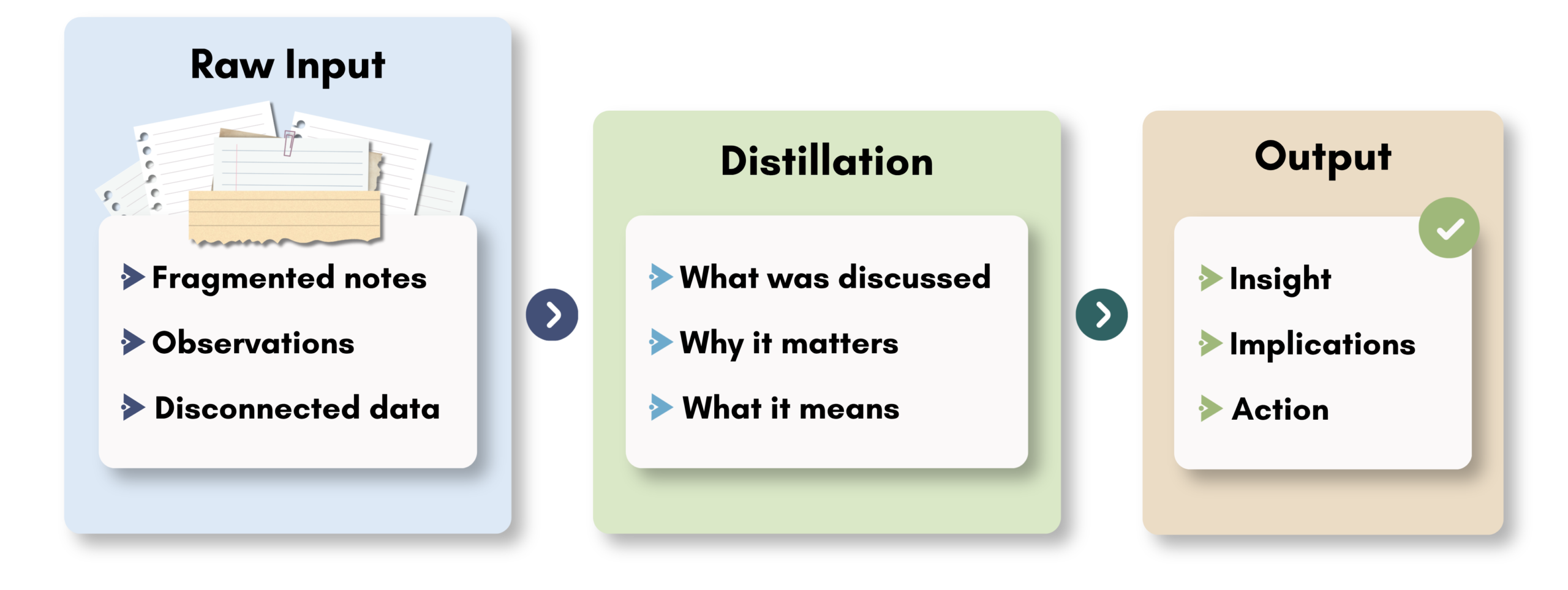
Raw notes are rarely useful in their original form.
They are fragmented, unstructured, and often filled with details that do not translate into meaningful action.
The real skill lies in distillation.
Across the teams we’ve supported, the ones that consistently deliver executive-level value are those that actively interpret information — not just record it.
That means identifying what was discussed, why it matters, and what should happen next.
For example, a discussion with a Key Opinion Leader (KOL) should not be summarized as a list of topics covered. It should be reframed as:
- what was discussed
- why it is important
- what implications it creates
That shift transforms notes into insight.
Another critical distinction is separating observation from interpretation.
An observation might capture that a study was presented or a dataset was discussed. An insight explains what that means for the treatment landscape, competitive positioning, or future strategy.
Without that layer of interpretation, summaries remain descriptive rather than useful.
Patterns Matter More Than Individual Data Points
Congress insights rarely emerge from a single presentation.
They emerge from patterns.
In practice, this means looking across sessions, conversations, and reactions to identify recurring themes. Competitor positioning, shifts in clinical thinking, and emerging barriers to adoption often become visible only when multiple signals are considered together.
This is where many summaries fall short.
They report isolated findings instead of connecting them into a coherent narrative.
Effective executive summaries prioritize a small number of key takeaways, typically three to four, that reflect meaningful patterns rather than individual data points.
When possible, these insights should be supported with concrete data or specific examples. Quantification adds credibility and makes the implications more tangible for leadership teams.
Structuring Information for Executive Consumption
Even strong insights lose impact if they are not structured properly.
Executives do not read reports linearly. They scan for conclusions, implications, and recommended actions.
What most teams underestimate is how much structure influences whether a summary is actually used.
One approach that consistently works is organizing summaries using a top-down structure:
- Start with the main conclusion
- Follow with the supporting insights
- Then outline recommended actions
This allows decision-makers to immediately understand what matters without having to work through pages of context.
Clarity is also critical.
Overly technical language or unnecessary detail can reduce accessibility, especially for cross-functional stakeholders. The goal is not to simplify the science, but to communicate it in a way that supports decision-making.
From Insight to Action
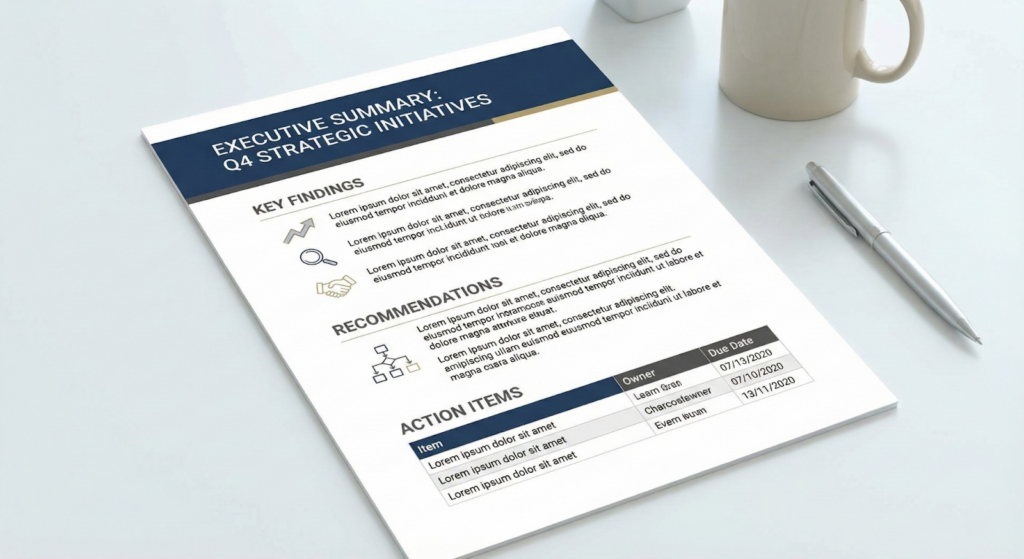
An executive summary is only valuable if it drives action.
The strongest summaries do not stop at interpretation. They include clear, actionable recommendations tied to ownership and timing.
What should the organization do differently as a result of these findings?
Which conversations need to happen next?
Where should resources be adjusted?
Without this level of specificity, even well-written summaries risk becoming static documents rather than tools for alignment and execution.
AI Is Changing How Teams Process and Synthesize Notes
As the volume of information captured at congresses continues to increase, many teams are turning to AI to help process and synthesize notes more efficiently.
AI tools can help organize large volumes of unstructured information, identify recurring themes, and accelerate the process of transforming notes into structured outputs.
But the same principle applies here as it does with abstracts.
The teams that see the most value are those that use AI to support their thinking — not replace it.
For a deeper breakdown of how to structure AI prompts and generate higher-quality summaries, see our guide on Best Practices for Using AI to Summarize Congress Abstracts.
They provide clear structure, define what matters, and use AI to accelerate the transformation of raw data into insight.
Why Executive Summaries Work Best Within a System
As congress workflows become more complex, the challenge has shifted from simply capturing information to managing it in a way that supports meaningful insight.
We’ve consistently seen Medical Affairs teams struggle with notes, presentations, and insights scattered across multiple tools, making it difficult to connect information or retrieve it later.
The teams that operate most effectively are those that treat congress reporting as a connected system, not a series of isolated tasks.
That experience ultimately led to the development of the inVision platform.
Instead of treating notes, slides, and discussions as separate inputs, the platform was designed to bring them together into a single analytical environment. By combining multiple sources of congress data, teams can identify patterns more easily and generate summaries that reflect a broader, more complete perspective.
The goal was not simply to organize notes.
It was to help teams produce clear, structured, and actionable executive summaries.
For Medical Affairs teams looking to move beyond fragmented notes and toward more structured, insight-driven reporting, inVision was built specifically for this challenge.
The platform helps teams synthesize congress data, organize insights across sources, and generate executive-ready summaries that support strategic decision-making.
Contact us ff you’re exploring how to improve the way your team captures and communicates congress insights, we’d be happy to show you how inVision works in practice.