
Over the past two decades, the inThought team has worked closely with Medical Affairs and MSL teams across hundreds of scientific congresses from smaller specialty meetings to the largest global medical congresses.
During this time, one pattern has become clear: the challenge is not access to information, but deciding what actually matters.
Between overlapping sessions, scheduled meetings, unexpected conversations, and constant exposure to new data, congresses can quickly become overwhelming. By the end of the event, many MSLs return with pages of notes but limited clarity on what is truly relevant.
The difference between a productive congress and a less efficient one comes down to how intentional you are with your time and attention.
In practice, the most effective MSLs approach congresses as structured, multi-phase engagements rather than a series of disconnected activities.
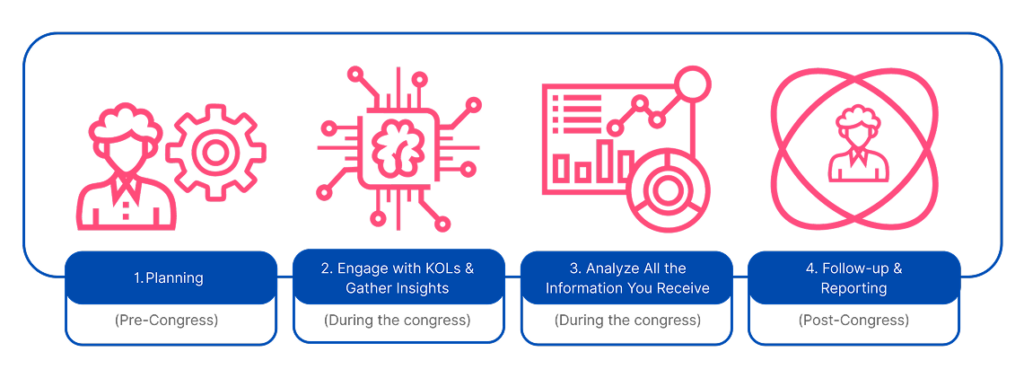
Pre-Congress: Preparation Defines Efficiency
Efficiency at a congress is largely determined before the first session begins.
The biggest mistake we see is when MSLs arrive with a full calendar but no clear prioritization strategy. Without that clarity, schedules become reactive and high-value opportunities are often missed.
Preparation starts with understanding who matters.
Identifying which KOLs will be present and which ones are most relevant to your therapeutic area allows you to focus your time where it will have the greatest impact.
In practice, the most effective MSLs enter congresses with a clear understanding of:
- the key scientific or strategic questions they are expected to answer
- the types of insights leadership is looking for
- the interactions that will have the greatest impact
From there, they build personalized schedules aligned with their objectives. They prioritize sessions that support their strategic focus and plan meetings in advance, often coordinating around booth availability to maximize efficiency.
But planning is not just about logistics, it’s about readiness.
Having materials prepared, discussion points refined, and a clear narrative for interactions ensures that every conversation is purposeful. The best MSLs don’t improvise their value proposition; they enter each interaction knowing exactly what they want to communicate and what they need to learn.
During the Congress: Execution Is About Selectivity
Once the congress begins, the challenge shifts from planning to execution.
For a more in-depth guide on how to prioritize time and capture high-value insights during the event, see our detailed guide on maximizing efficiency during a conference.
What most teams underestimate is that efficiency comes from choosing where to focus, not simply trying to do more.
What separates high-performing MSLs from the rest is their ability to prioritize where their time creates the most impact, rather than simply filling their schedules.
The most effective MSLs do not limit themselves to scheduled meetings. They actively engage in informal interactions during breaks, poster sessions, and networking events, where some of the most valuable insights often emerge.
In practice, this means focusing on:
- high-value KOL interactions rather than maximum volume
- informal conversations where unfiltered insights often surface
- capturing insights in a structured way, not just recording information
At the same time, they approach KOL interactions with clarity and precision.
Strong engagement goes beyond delivering information and focuses on creating meaningful scientific exchange. This requires clear messaging, relevant data, and the ability to adapt conversations based on the stakeholder.
Equally important is how information is captured.
The biggest mistake we see is passive note-taking, recording information verbatim without structure or intent. High-performing MSLs actively filter what they hear, capturing key insights, signals, and potential actions in real time.
They also remain aware of the broader environment.
Observing competitor presence, engaging with vendors, and staying updated on emerging technologies all contribute to a more complete understanding of the landscape.
Efficiency in this phase comes down to awareness and prioritization.
Post-Congress: Value Is Created in the Follow-Up

For many teams, the congress feels like it ends when they leave the venue, even though the real value is created afterward.
Raw notes and fragmented observations do not drive decisions. What matters is how quickly and effectively those inputs are translated into insight and action.
Effective post-congress execution typically includes:
- rapid internal debriefs to align on key takeaways
- concise summaries focused on implications, not descriptions
- timely follow-ups with KOLs to reinforce relationships
Sharing insights with internal teams shortly after sessions allows organizations to align while the information is still fresh. It also helps identify patterns across different interactions and sessions.
From there, structured reporting becomes essential.
The most effective summaries are not long descriptions of what happened. They focus on key insights, implications, and recommended next steps tailored to the needs of different stakeholders.
Across teams we’ve worked with, the ones that create the most impact are those that move quickly from information to interpretation, not just documentation.
Follow-up with KOLs is equally important.
Timely, personalized communication reinforces relationships and extends the value of congress interactions beyond the event itself. In many cases, sharing relevant insights with stakeholders who were not present can open the door to future engagement.
This is where congress participation transitions from activity to impact.
Congress Efficiency Is a System Not a Checklist
It’s easy to think of congress success as a series of tasks: attending sessions, meeting KOLs, taking notes, and writing reports.
What actually works is treating congress participation as a connected system rather than a set of isolated activities.
- Preparation informs execution.
- Execution feeds insight.
- Insight drives action.
When these phases are connected, congresses become far more than busy events. They become structured opportunities to influence strategy, strengthen relationships, and generate meaningful scientific intelligence.
Why Congress Management Works Best Within a System
As congress participation becomes more complex (especially for larger teams) managing schedules, notes, and insights across multiple tools becomes increasingly difficult.
We’ve consistently seen Medical Affairs teams struggle with fragmented workflows, where information is scattered across emails, spreadsheets, and personal notes. This fragmentation makes it difficult to identify patterns, share insights, or build on previous congress learnings.
That experience ultimately led to the development of the inVision platform.
Rather than treating planning, note-taking, and reporting as separate processes, the platform was designed to bring them together into a single system. Teams can coordinate schedules, capture insights in real time, and organize information in a way that remains searchable and accessible long after the event ends.
The goal was not simply to improve organization.
It was to help teams operate with greater clarity, alignment, and efficiency across every phase of congress participation.
For Medical Affairs teams looking to improve how they plan, execute, and follow up on congress activities, inVision was built specifically for this challenge.
The platform helps teams manage schedules, centralize insights, and transform congress activity into structured, actionable intelligence.
If you’re exploring ways to make your congress strategy more effective, feel free to reach out. We’d be happy to show you how inVision works in practice.