
At most scientific congresses, the real work for a competitive intelligence team doesn’t end when the sessions do. It starts when the team returns with pages of session notes, abstract screenshots, booth observations, and hallway conversations, and are expected to tell leadership what actually changed.
After years of working with intelligence teams tracking competitors across congresses, one pattern stands out. Raw congress capture only becomes intelligence when someone translates it into a clear read on how the competitive picture moved.
The trap is a familiar one. A team monitors the right sessions, captures the right data, and then reports back with a long chronological summary of everything that was presented. Leadership doesn’t need a play-by-play of the meeting. They need to know what shifted, whether it matters, and what the organization should do about it.
What separates a congress recap from a useful competitive brief isn’t how much you captured. It comes down to interpretation.
The Deliverable Isn’t a Recap, It’s a Read on What Moved
Most teams treat congress reporting as a documentation exercise: capture every relevant presentation, every competitor data point, every management comment. The output is thorough, but it leaves the reader to figure out the “so what” on their own.
Leadership isn’t asking for completeness. They’re asking what changed relative to what the organization already believed.
The most useful competitive briefs are built around a single test. Every item has to answer “what does this change about our understanding of the competitor, program, or market?” If a finding doesn’t shift an assumption, inform a decision, or raise a flag worth monitoring, it doesn’t belong in the executive-facing brief.
That’s a real mindset shift. The goal isn’t to report competitor activity, it’s to translate that activity into strategic implications.
The Best Briefs Are Scoped Before the Congress Starts
The quality of a post-congress brief is mostly determined before anyone arrives on site.
The most common failure is walking into a congress without a defined set of intelligence questions. Without that direction, coverage becomes reactive. Analysts capture whatever is in front of them, and the signals that actually matter get lost in the volume.
Teams that consistently produce high-value briefs start from the questions leadership needs answered. Which competitor readouts could change our positioning? Which program timelines are we watching? What would a competitor have to show for us to rethink an assumption? That context decides what gets prioritized during sessions, so the hard work of distillation is already half done by the time the congress ends.
From Raw Capture to Signal
Raw congress notes are rarely useful in their original form. They’re fragmented, unstructured, and full of detail that never translates into a decision.
The skill is distillation, and specifically, separating an observation from its competitive implication.
An observation records that a competitor presented a Phase 2 readout, or that a management team repeated a particular positioning line. A signal explains what that means: how the data compares with the competitor’s prior disclosures, whether it strengthens or weakens their differentiation, and what it implies for the landscape.
A useful way to structure each item is a simple chain of Signal, Context, Change, Implication, and Recommended follow-up:
- Signal: what was observed (a readout, a claim, a timeline update)
- Context: how it compares with what we previously knew
- Change: what’s actually different now
- Implication: why that matters competitively
- Recommended follow-up: what to monitor or verify next
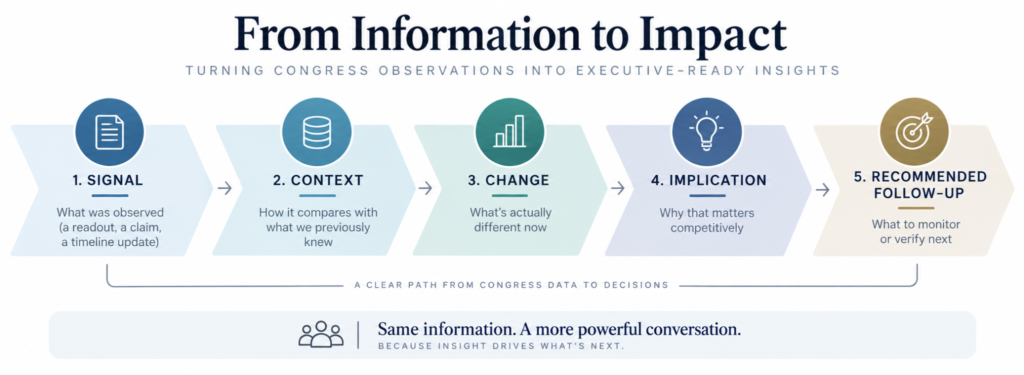
Without that interpretation layer, a brief stays descriptive when leadership needs it to be decision-ready.
Patterns Matter More Than Individual Data Points
Competitive signals rarely come from a single presentation. They emerge from patterns: the same competitor reinforcing a message across multiple sessions, a shift in how several KOLs discuss a mechanism, a cluster of trial updates that together suggest a change in strategy.
This is where many briefs fall short. They report isolated findings instead of connecting them into a coherent read on the competitor’s direction.
Strong competitive briefs prioritize a small number of key takeaways, usually three or four, that reflect meaningful patterns rather than one-off observations. Where possible, each is grounded in something concrete: a specific data point, a direct comparison with a prior disclosure, a named source. That grounding does double duty for a CI audience. It makes the implication tangible, and it gives the reader traceability back to where the signal came from, which matters when leadership challenges a conclusion.
Structuring the Brief for Executives
Even sharp signals lose their impact if they’re buried. Executives don’t read intelligence briefs linearly. They scan for conclusions, implications, and what the team recommends watching.
A top-down structure consistently works:
- Lead with the headline read on what changed competitively
- Follow with the supporting signals and how they compare with prior understanding
- Close with recommended monitoring or actions
That lets a decision-maker grasp what matters without working through pages of session detail. It also helps to keep the language accessible for cross-functional stakeholders, since brand, clinical development, BD, and executives will all read the same brief, and each needs to act on it without a translation step.
From Insight to Action

A competitive brief is only worth producing if it drives something. The strongest ones don’t stop at interpretation. They tie each material signal to a next step.
What should the team keep watching? Which assumption needs to be revisited? Where does a signal warrant deeper verification before we treat it as fact? Which internal stakeholder needs to hear about this before the next planning cycle?
Being explicit about confidence matters here too. Decision-makers need to know which conclusions are well-supported and which are early reads based on a weak signal, so leadership can weigh them appropriately. Without that specificity, even a well-written brief becomes a static document instead of a tool for action.
Why This Works Best Inside a System
As congress coverage grows more complex, the challenge shifts from capturing information to managing it in a way that supports a genuine competitive read. When notes, abstracts, and prior-year baselines live across separate tools, it’s hard to compare this year’s signal with last year’s disclosure, or to see a pattern forming across sessions.
Teams that operate most effectively treat congress intelligence as a connected system rather than a series of isolated tasks, where current capture sits alongside the historical baseline, so changes are easier to spot and briefs reflect a fuller picture.
That’s the problem inVision was built to address: bringing congress data, prior disclosures, and analysis into a single environment so intelligence teams can identify what changed and produce executive-ready briefs, rather than reassembling context from scratch after every meeting.
If you’re looking at how your team turns congress coverage into competitive intelligence leadership can act on, contact us and we’d be glad to show how inVision works in practice.